Showing posts with label FYI. Show all posts

Sunday, September 25, 2011

FYI: Vaccine-preventable diseases

Last week at the Social Good Summit, there were many panels devoted to women-centric issues: Christy Turlington spoke about reducing deaths in women due to childbirth and news anchor Juju Chang covered maternal health in the developing world. In many of these sessions, the story wasn't just a strengthened focus on women issues but also putting women in the seat of the activist, especially moms. Nonprofits are now targeting mothers in America  as a key activist group to impact women and children in the developing world.

An organization that is aiming to utilize this power of mothers' voices is Shot@Life. Launched by the UN Foundation at last week's Social Good Summit, the campaign aims to create awareness on vaccine-preventable diseases and provide children vaccines where they are needed the most. Part of the problem is that many developing nations need to strengthen their health systems to properly store and administer vaccines. The numbers are grim (see below) but expanding access to vaccines can prevent an additional 1.7 million deaths each year.

The numbers:
  • Every 20 seconds a child dies to a vaccine-preventable disease.
  • 1 in 5 children do not have access to life saving vaccines. 
  • Around 1.7 million children in developing countries die each year of a preventable disease like pneumonia, diarrhea, measles, and polio.
  • Measles is still a killer with  an estimated 450 people dying to the disease each day.
  • Though polio is almost near eradication, it still remains endemic in four countries: Afghanistan, India, Nigeria, and Pakistan. There has been a resurgence of polio in other countries, such as Angola, Chad, and the Democratic Republic of the Congo.
  • The rotavirus is the most common cause of diarrhea in children. More than half a million children under age five die as a result of rotavirus each year.  Approximately 2 million more become severely ill.
  • Access to vaccines is particularly problematic in some countries:  75% of non-vaccinated children live in just 10 countries -  India, Nigeria, Pakistan, Indonesia, Democratic Republic of Congo, Ethiopia, China, Uganda, Chad, and Kenya. 
Watch the full panel discussion from Social Good Summit:


    Watch live streaming video from mashable at livestream.com

    Thursday, September 1, 2011

    FYI: How to prevent a famine

    Source: REUTERS/Thomas Mukoya

    Speaking at a meeting in Kenya on food crises, agricultural experts agreed to four ways to prevent future famines in the Horn of Africa. The panelists included representatives from CGIAR Consortium, UN Somalia Food Cluster of the World Food Programme, Alliance for a Green Revolution in Africa (AGRA), and the Kenya Agricultural Research Institute (KARI).

    AlertNet summarized the meeting with the top four ways future famines could be prevented:

    • Get the private sector to adopt new research
    Investing in innovations can not only help to curb hunger but can also seed future businesses in the region. For example, KARI has helped to develop sorghum in the region. East African Breweries, the largest beer company in the region, is investing $2.6 million in buying the sorghum from small-scale farmers.

    • Eat different foods
    Investing in famine-resistant crops and changed food preferences can help the region.
     
    • Invest in livestock and agriculture
    “Modest investments in agricultural research that allow the world’s most vulnerable people to take charge of their food security are far less expensive than constantly parachuting in with food aid and humanitarian assistance,” said Lloyd Le Page, CEO of Consultative Group on International Agricultural Research (CGIAR). “Yet donors and governments continue to fall short of their promise to boost investments in the farm sector.”

      • Use irrigation to support pastoralism, not switch to farming
      "The food crisis in the Horn is essentially a livestock crisis,” said Le Page. “The best way to prevent famine in arid lands is to ensure access to critical dry season grazing and water areas for livestock.”

        Tuesday, August 23, 2011

        FYI: The developing world's toilet crisis


        The Gates Foundation recently announced a contest to create an innovative toilet. No, the purpose isn't to produce a new, shiny apparatus for your bathroom. Rather, the Gates Foundation wants to address the world's toilet crisis: 40% of the world's population still have no access to toilets.

        Here is a roundup of why having access to a toilet is so important:


        Health:
        • 2.6 billion people have no access to a toilet. Of this group, 75% live in rural areas.
        • Poor sanitation can lead to diarrhea. 2.2 million people die from diarrhoeal diseases every year, according to WHO.
        • Diarrhoeal diseases are the second most common cause of death in children under five. 88% of these deaths were caused by lack of sanitation, poor hygiene practices and contaminated drinking water.
        • Intestinal worms are also a problem for those who lack proper sanitation facilities. Children in poor environments often carry 1,000 parasitic worms in their bodies at a time. 
        • Getting sick from poor hygiene and sanitation means a loss of income for families, missed school, and extra expenditure on medications.
        Social development:
        • Schools in the developing world are often built without toilets and washrooms. This is one reason why teenage girls often drop out of school as there are no private places to change menstruation cloths/napkins.
        • Many women walk to remote areas to defecate and often face the risk of violence at nighttime.
        Environment:
        • 90% of human excrement end up untreated in rivers in the developing world. 
        • Sewage dumped at sea or carried upstream by rivers increases the level of nitrogen in bodies of water, leading to the loss of aquatic life.
        Watch Current TV's Adam Yamaguchi travel around Asia, detailing the problems and solutions associated with the world's toilet crisis:

        Monday, July 11, 2011

        FYI: MDGs Progress

        The deadline set for the Millennium Development Goals is just four years away. Are we anywhere near success?

        According to the UN report released a few days ago, progress of MDGs is a mixed bag. Find out where we are succeeding and where countries need to beef up their commitments.

        The good:
        • The global poverty rate is set to drop to below 15%, a better percentage than the 23% goal set out by the UN. 
        • Child mortality rates have improved. In 1990, the number of children under the age of 5 who died was 12.4 million. In 2009, this number dropped to 8.1 million.
        • Deaths from malaria have decreased 20% since 2000.
        • HIV infection rates have dropped 21% since 1997.
        • Approximately 1.8 billion people now have access to clean and safe drinking water.
        The not so great:
        • Development has been uneven and large gaps of peoples within countries are not reaping any benefits from progress in the MDGs. 
        • The poorest children are still behind in progress with regards to nutrition. In 2009, a quarter of children in the developing world were underweight. 
        • Areas of conflict damper any development progress. For example, 28 million or 42% of primary school age children who are not enrolled in school live in conflict affected areas.
        • Employment opportunities for women are still slim and with the recent global economic downturn, growth in employment for women was lower than for men. 
        • More than 2.6 billion people still lack access to toilets.

        Thursday, June 30, 2011

        FYI: The causes of the food crisis

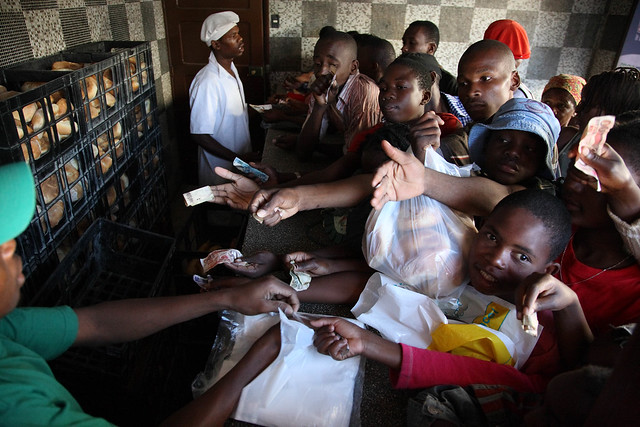
        Rushing to buy bread as wheat runs short and food prices rise in Mozambique.  Source: ILRI


        A few weeks ago, I went to my favorite neighborhood Malaysian restaurant for some spicy cuisine. Much to my surprise, I had to pay extra for the rice to complement my main dish. Pay for rice? At an Asian restaurant??? Unheard of!!

        The reality is that crop prices have been rising over the past few years, affecting restaurants and grocers. But it also means that many in the developing world are losing access to crops and food.  

        According to Food and Agricultural Organization of the UN, in 2010, there were 925 million people in the world who did not eat enough to be healthy. That translates to one in every seven people that goes to bed hungry each night worldwide. Between June 2010 and February 2011, rising food prices caused an additional 44 million people to go into hunger, making it the highest level ever.

        So why are prices of food rising? Here is a roundup of some of the causes:
          
        • Increased food consumption: As large countries like India and China develop and their middle classes grow, their food consumption also increases. This has caused a greater demand for food globally.
        •  Weather conditions: Droughts, floods, and other natural disasters have plagued crop-producing regions more-so since 2008 than in previous years. Droughts, in particular, have occurred in Australia, the Balkans, Russia, and most recently, in the Horn of Africa.
        •   Federal reserves are low: Global grain reserves – wheat, corn, barley, millet, rice, and oats - are at their lowest level since 1960.
        •  Increased fuel prices: With oil prices rising, farmers can’t afford the higher transportation costs as well as the costs to commercially produce food.
        •  Lack of agricultural investment: In many developing countries, the investment in agriculture has dropped, with governments focusing their attention on urbanization.
        •  Use of crops for biofuels: Grains, such as corn and palm oil, have increasingly been used for biofuel production, raising the prices of other grains.
        •  Devaluation of the US dollar: Many crops are based on the US currency for pricing.